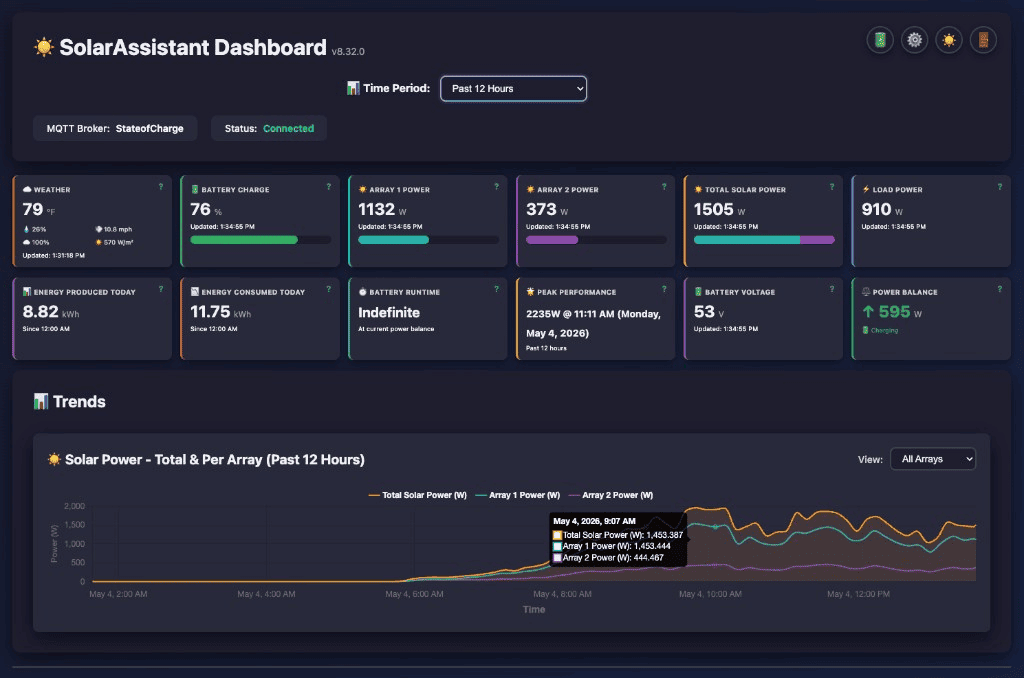
The screenshot above is what “integrated” feels like in action: broker status in plain language, weather beside generation, battery state beside load, and a trend line that lets you compare intuition against history. That kind of UI does not appear because someone wished for pixels—it appears when MQTT topics, REST APIs, email pipes, and automation hooks are mapped before anyone wires the first script. That upfront clarity is the part of an AI-ready development path people skip when they chase prompts without architecture: models accelerate typing; humans still owe the system a source of truth.
MQTT: small messages, fast heartbeat
MQTT is a lightweight publish–subscribe protocol—think of it as a bulletin board for machines. Instead of every device polling a server on a fixed schedule (“Are we there yet?”), components publish updates to named channels (topics) and subscribers listen for what matters to them. It was built for unreliable networks, which is why it shows up around solar, batteries, and field gear. The protocol itself is maintained in the open; the official overview at mqtt.org is a good starting point if you want the non-marketing version.
For a project like SolarAssistant, MQTT matters because solar data is continuous and bursty: clouds move, loads switch on, inverters adjust. You want near-real-time paths from hardware into software without hammering APIs or opening dozens of bespoke sockets. When the dashboard shows “MQTT Broker: Connected,” it is signaling that this nervous system is alive—if it drops, your UI might still render, but the numbers are no longer trustworthy.
Victron and the VRM API: the cloud-side ledger
Victron’s ecosystem is familiar to many battery and inverter installs. Their VRM (Victron Remote Management) portal aggregates history and alarms from equipment in the field. The VRM API lets software pull that structured record—summaries, sites, trends—so your own tools do not have to reinvent logging. Official documentation lives in Victron’s developer materials; a stable entry point is VRM API documentation, alongside the broader vendor context at victronenergy.com.
Why pair MQTT with VRM at all? MQTT often carries now; VRM helps validate what happened over hours and days. When both agree, operators sleep better. When they diverge, you know which layer to debug first—local broker versus cloud ingest—instead of guessing.
Ambient Weather: context outside the panel
Solar production is not determined by the inverter alone. Irradiance, temperature, and wind affect what you should expect hour by hour. Ambient Weather hardware and the Ambient Weather Network ecosystem give owners a structured way to expose local station data—often consumed via API keys tied to your devices—so software can line up “what the sky did” with “what the arrays reported.” Product and support details sit with the vendor at ambientweather.com.
That correlation matters for sanity checks: if production collapses but weather says full sun, you investigate shading, faults, or wiring—not spreadsheet myths.
SendGrid: when numbers must become messages
Dashboards help people who are watching. Email and alerts help people who are not. SendGrid (with API reference at docs.sendgrid.com) is one mature option for turning threshold breaches—battery low, inverter fault, comms loss—into delivered mail with predictable authentication and bounce handling. On projects we ship, server-side patterns like PHP posting JSON to a mail API keep secrets off the client, similar to the contact pipeline documented in this site’s README.
The integration idea is simple: telemetry triggers become human-readable stories in an inbox, not raw JSON in a log file only engineers read.
IFTTT: glue for human workflows
IFTTT (“If This Then That”) is a consumer-friendly automation fabric: link channels, define triggers, fire actions. It is not a replacement for industrial controls, but it shines at connecting SaaS edges—push a notice to your phone, toggle a smart plug, append a row to a spreadsheet—when a webhook or email path fires. In an energy stack, IFTTT often sits where “we need someone to know” meets dozens of vendor-specific apps: it routes signals into habits people already use.
Think of MQTT and APIs as facts moving machine-to-machine; think of IFTTT as the gentle layer that nudges humans when facts cross a line you care about socially, not only electrically.
Why undocumented data breaks solar reliance
If you depend on solar—whether for a home, a remote site, or a business with uptime promises—bad data is worse than no data. Undocumented field names, mystery scaling factors, and “we fixed it in the spreadsheet” routines create confident wrong decisions: draining a battery you thought was half full, exporting to the grid when you meant to cover a peak, or missing inverter faults until hardware enforces the lesson.
Validated data means you know the unit (volts versus percent), the sampling cadence, the timezone, and the path from sensor to screen. It means alarms reference the same identifiers your APIs use. It means when AI suggests an optimization, reviewers can trace inputs to a primary source—not to a hallucinated parameter from an old forum post.
Solar energy carries physical consequences: equipment wear, fire risk when wiring is wrong, and economic loss when tariffs or incentives depend on measured production. A disciplined integration path—like the stack implied by a SolarAssistant-grade dashboard plus vendor APIs—exists precisely to keep those consequences visible early, not after the bill arrives.
The takeaway
An AI-assisted build only earns trust when the plumbing is boring on purpose: MQTT for live state, Victron’s cloud record for history, Ambient for sky context, SendGrid for delivery, IFTTT where humans live, and documentation that ties each stream to a testable meaning. SolarAssistant illustrates how that discipline surfaces as a single credible dashboard—exactly the outcome teams want when energy stops being a brochure promise and becomes operations.
If you are wiring telemetry, mail, and automation into one story, we can help you keep the architecture legible while delivery accelerates—so the numbers on screen stay worth betting on.